

Gippsland Critical Minerals’ (GCM) Mining and Rehabilitation Demonstration Pit (MRDP) has reached the next stage of the trial, with tailings now returning to the pit ahead of overburden replacement and rehabilitation.
The new progress follows the completion of excavation works and the commencement of ore processing through the demonstration separation plant.
Extracting valuable critical minerals using only water and gravity, ore is mixed with water to separate heavier minerals from the surrounding sand. The demonstration plant uses the identical spiral type proposed for the full-size plant and has performed exactly as planned.
Once the valuable minerals have been separated, about 95 per cent of the mined material remains to be returned to the pit through a process known as ‘in-pit tailings storage’.
Unlike some other forms of mining that can rely on chemical extraction, mineral sands tailings consist largely of naturally occurring sand and clay. Following gravity separation, the material is then returned to pit as a slurry, where the solids settle and the water is recovered for reuse, completing the ‘in-pit disposal’ process.
GCM Project Director Technical, Stefan Wolmarans, said the current activity demonstrated careful planning producing consistent and expected results.
“In-pit disposal of tailings is recognised as best practice on mineral sands critical minerals projects around the world, because it allows rehabilitation to occur progressively and maximises water recycling.” Stefan said.
“Water and gravity do the work of separating the valuable minerals from the ore sand. The remaining material is returned to the pit, with the water recovered and recycled back through the plant, and the process continues.”
Stefan explained mineral sands processing borrows common mining industry terminology like ‘tailings’ but is fundamentally different from many other forms of mining.
“No toxic chemicals are used during this process. What is returned to the pit is the original sand, with the valuable heavy minerals removed,” said Stefan.
“As only a very small percentage of the material is removed as HMC product during separation, we can return the land very closely to the original pre-mining contours “
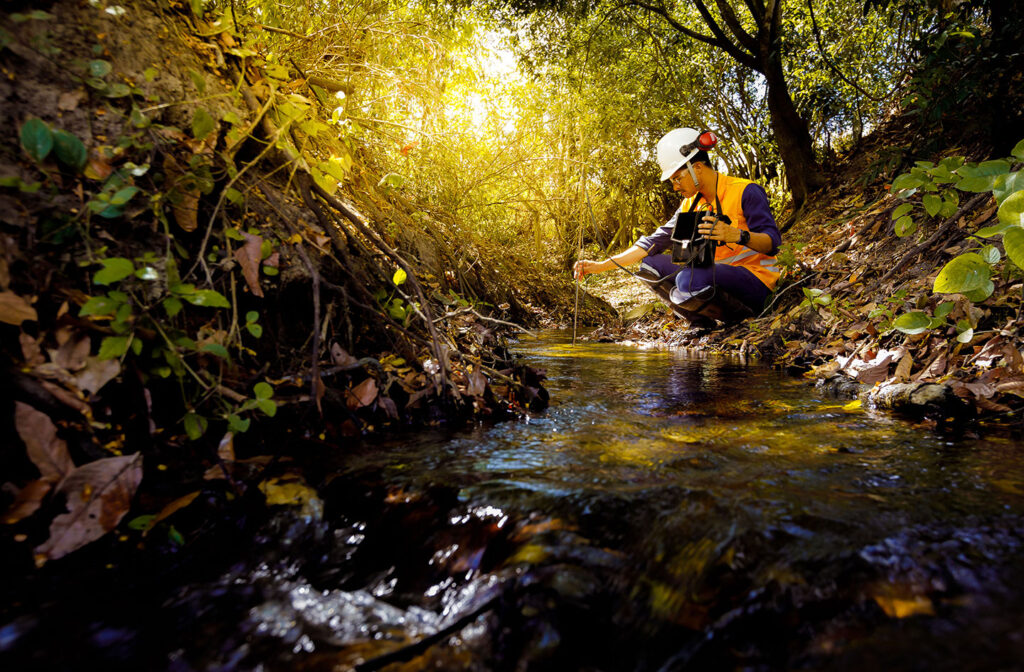
Water management remains a key focus of the demonstration program. Instruments installed beneath the pit are collecting water throughout the trial, enabling GCM to monitor and verify conditions at each stage of tailings placement and rehabilitation.
Frequent sampling by an independent laboratory will also confirm earlier laboratory test work which determines that the tailings water is environmentally benign.
Improving water recovery, a flocculant commonly used in water treatment and agricultural applications is used to help fine clay particles within the tailings settle more quickly, enabling water to be recycled through the water system.
Monitoring undertaken before and during the demonstration program continues to confirm that mining does not intersect regional groundwater systems. Groundwater remains more than 45 metres below the deepest point of the demonstration pit.
“One of the purposes of the Demonstration Pit is to verify our modelling and investigations under real operating conditions, and the monitoring data continues to align with the findings of our extensive drilling program,” Mr Wolmarans said.
“Data from approximately 880 drilling locations across the project area has informed detailed geological and groundwater modelling for the Fingerboards area. Each stage of the work is measured, tested and verified, providing important evidence to support the project’s environmental assessment.”
Over the coming weeks, tailings placement will continue before the pit is fully refilled with overburden ready for the next important phase of the MRDP to begin.
Rehabilitation trials will then get underway, including careful replacement of the stored subsoil and topsoil, followed by the establishment of pasture and cover crop test plots.
The final phase of the MRDP will keep the site active over coming years, with long term monitoring of the landform profile, soil chemistry and revegetation to continue after the rehabilitation has been completed.
Community tours of the Demonstration Pit will continue throughout July. Anyone interested in attending can register at gippslandcriticalminerals.com/mrdp-guided-tours.